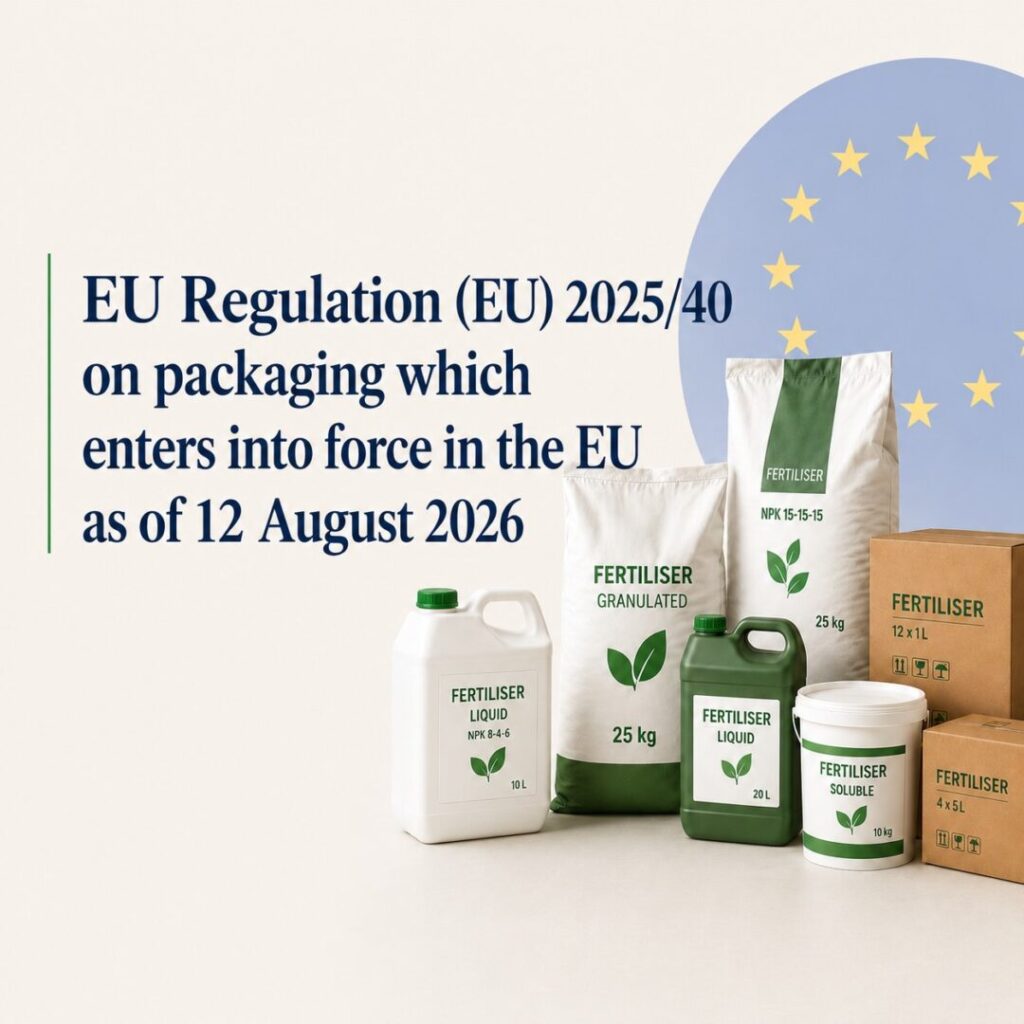
On 12 August 2026, the general application of Regulation (EU) 2025/40 on packaging and packaging waste, commonly known as the PPWR, will begin.
From a legal perspective, the Regulation will not enter into force on that date, as it already entered into force on 11 February 2025. However, from 12 August 2026, most of its provisions will begin to apply directly in all Member States of the European Union.
Regulation (EU) 2025/40 introduces a common framework governing the entire life cycle of packaging, from its design and manufacture to its reuse, collection, recycling and management as waste. Its scope covers all packaging, regardless of the material used or the sector in which it is marketed. It therefore also applies to packaging used for fertilisers, biostimulants and other agricultural products.
What will happen to national packaging legislation?
The application of the European Regulation does not automatically result in the disappearance of all national legislation on packaging and packaging waste currently in force in the different Member States.
From 12 August 2026, Regulation (EU) 2025/40 will be directly applicable throughout the European Union and, in the event of a conflict, will take precedence over national provisions.
National legislation may continue to apply to matters that are not regulated by the Regulation, that require implementation by the Member States or that are not incompatible with the European framework.
Member States will have to adapt their respective legal and administrative frameworks to the new Regulation and develop those matters that must be managed at national level.
Until these adaptations have been completed, companies will need to assess Regulation (EU) 2025/40 together with the national obligations that remain applicable in each country where their products are marketed.
Which companies will be affected?
The Regulation applies to all operators involved in the manufacture, supply, import, distribution, marketing or management of packaging and packaged products.
To comply correctly with the legislation, each company will need to identify the role it performs. A company marketing a packaged product under its own name or trademark may be considered the manufacturer, even when the packaging has been produced by an external supplier.
In addition, the same company may act as a manufacturer, importer, distributor or producer subject to extended producer responsibility, depending on the type of packaging, the sales channel and the Member State in which the product is marketed.
Main obligations from 12 August 2026
Although many significant measures will be introduced progressively over the coming years, several general obligations will begin to become relevant from August 2026.
Conformity assessment of packaging
Before placing packaging on the European Union market, the manufacturer will be required to carry out the conformity assessment procedure established in the Regulation for the requirements already applicable.
The manufacturer will also need to prepare the relevant technical documentation and issue an EU declaration of conformity for the packaging. This documentation must be kept up to date and retained for:
Five years for single-use packaging.
Ten years for reusable packaging.
Suppliers of packaging and packaging materials will be required to provide the manufacturer with the information, specifications, test results and other documentation needed to demonstrate compliance.
The EU declaration of conformity for the packaging should not be confused with the CE marking of the packaged product. In the case of fertilisers, the packaging documentation will be separate from any conformity assessment applicable to the fertilising product under Regulation (EU) 2019/1009.

Control of substances present in packaging
Packaging must be manufactured in such a way as to minimise the presence and concentration of substances of concern.
As a general requirement, the sum of the concentrations of lead, cadmium, mercury and hexavalent chromium present in the packaging or its components must not exceed 100 mg/kg, except where expressly provided otherwise.
Identification and traceability
Manufacturers must ensure that packaging can be identified by means of a type, batch or serial number, or another equivalent element.
They must also indicate their name, registered trade name or trademark and a postal contact address. Where the nature or size of the packaging does not allow this information to be included directly, it may be provided through a digital medium or a document accompanying the product.
Economic operators must also be able to identify the companies that supplied the packaging to them and the companies to which they subsequently supplied it.
Responsibilities of importers and distributors
Importers will be required to verify that the manufacturer has carried out the conformity assessment, prepared the technical documentation and complied with the applicable identification and information requirements.
Distributors, for their part, will need to act with due care and must not market packaging where they have reason to believe that it does not comply with the Regulation.

Extended producer responsibility in the European Union
The application of Regulation (EU) 2025/40 does not remove the registration, reporting and financing obligations relating to the management of packaging waste that must be fulfilled in the different Member States.
Although the Regulation establishes a common European framework, extended producer responsibility will continue to be managed through the systems and competent authorities of each Member State.
Companies will therefore need to review, among other matters:
Registration in the relevant Member State’s packaging producer register.
Participation in a collective extended producer responsibility scheme or individual compliance.
Periodic reporting of packaging placed on the market.
The obligations applicable to the different packaging categories established under each national system.
The appointment of authorised representatives where required.
Companies marketing packaged products in several Member States will need to assess their extended producer responsibility obligations separately in each country, as registration or participation in a scheme in one Member State does not necessarily ensure compliance throughout the rest of the European Union.
How does this affect the fertiliser and biostimulant sector?
Companies in the sector will need to manage two different but related areas of compliance.
On the one hand, the fertiliser or biostimulant product must comply with the legislation applicable to it, such as Regulation (EU) 2019/1009, the national legislation applicable in each Member State, the CLP Regulation, REACH or the rules governing the transport of dangerous goods.
On the other hand, the packaging must comply with the specific obligations established by Regulation (EU) 2025/40 and with any national provisions that remain applicable in each country.
How can Sun Chemicals Services help?
The application of Regulation (EU) 2025/40 will require companies to coordinate European packaging legislation with the specific marketing requirements applicable to each product and with the national obligations in force in the different Member States.
At Sun Chemicals Services, we help manufacturers, importers and distributors of fertilisers and biostimulants assess how the new legislation affects their products and operations within the European Union.
Carrying out this assessment in advance will make it possible to identify documentation gaps, adapt agreements with suppliers and plan design changes before they affect the marketing of the products.
12 August 2026 does not represent the end of the adaptation process, but rather the beginning of a gradual transition towards a more harmonised, documented and circular European packaging system.
To learn more about our services, please contact our team.

July 2026

Sun Chemicals Services Team