
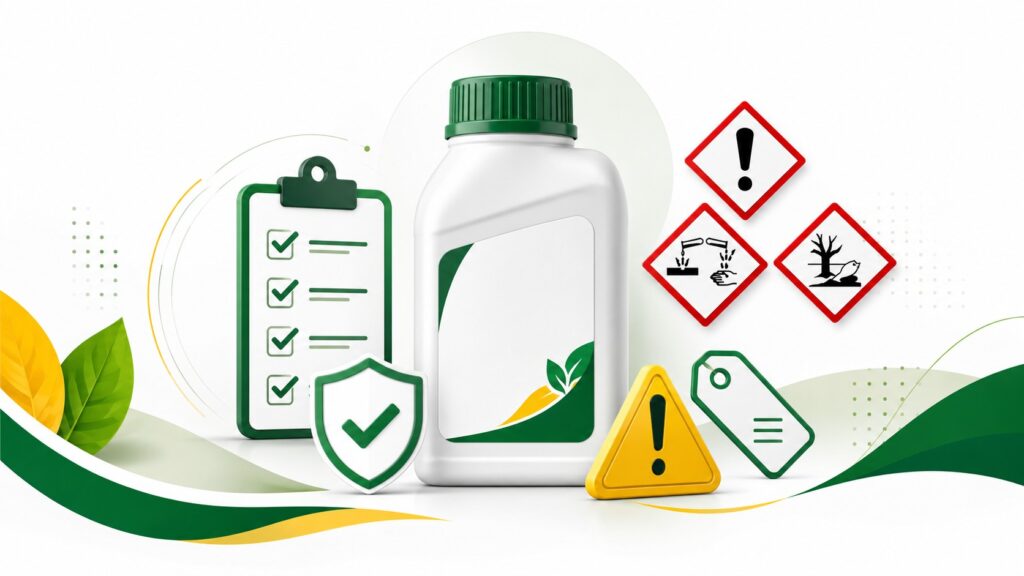
The label of a fertiliser or biostimulant is an essential part of its marketing. Incorrect information may lead to delays, requests from the competent authorities, penalties or reputational damage to the company.
For this reason, before placing a product on the market, it is important to determine which legislation applies and what information must appear on its label.
Which legislation must the label comply with?
Depending on the marketing route, a fertilising product can be subject to:
- Regulation (EU) 2019/1009, for CE-marked EU fertilising products.
- The national fertiliser and biostimulant legislation of the relevant EU Member State.
- The CLP Regulation, when the product is classified as hazardous.
- The REACH Regulation, when a safety data sheet is required.
In addition, if the product is marketed in other European countries, the label must be adapted to the language of the destination market.
What information must a label contain?
The exact content depends on the type of product, but it will normally include:
- Product name and category.
- Adaptation to the national legislation of the 27 EU Member States.
- Nutrients, microorganisms or other declared characteristics.
- Instructions, application rates and methods of use.
- Storage conditions and warnings.
- Net quantity.
- Details of the manufacturer, importer or operator responsible for placing the product on the market.
- Batch number or other identification ensuring traceability.
- CE marking, where applicable.
- Registration number, where required.
The information on the label must be consistent with the product’s composition, analytical results, safety data sheet and technical documentation.
Products classified as hazardous
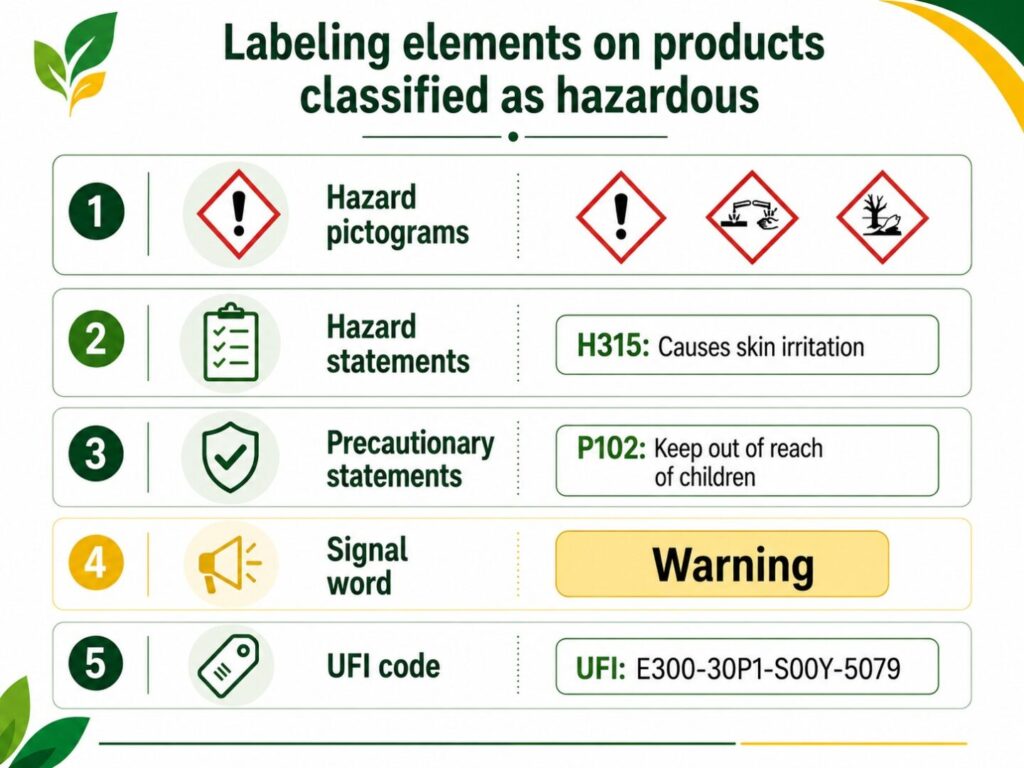
When a fertiliser is classified as hazardous, its label may need to include:
- Hazard pictograms.
- Hazard statements.
- Precautionary statements.
- Signal word.
- UFI code.
In certain cases, a PCN notification to poison centres must also be submitted before the product is placed on the market.
Common labelling errors
The most common errors include using incorrect product names, declaring contents that do not match the analytical results, making unjustified claims, indicating unsuitable application rates, omitting mandatory information, or presenting inconsistencies between the label, safety data sheet, and technical documentation. It is also common to translate a label without adapting it to the regulations of the destination country.
How can Sun Chemicals Services help you?
At Sun Chemicals Services, we help manufacturers, importers and distributors prepare compliant labels for fertilisers and biostimulants.
Our services include:
- Preparation and review of labels.
- Adaptation to Spanish and European legislation.
- Review of composition, guaranteed contents, application rates and claims.
- Product classification in accordance with the CLP Regulation.
- Preparation and review of safety data sheets.
- Generation of UFI codes.
- Preparation of PCN notifications.
- Review of consistency between the label and the technical documentation.
For further information about our services, please contact our team.
July 2026
Sun Chemicals Services Team
#FertiliserAndBiostimulantLabelling #FertiliserLabelling #Biostimulants #Fertilisers #EURegulation #EURegulation20191009 #CLP #REACH #UFI #PCN #SunChemicalsServices