
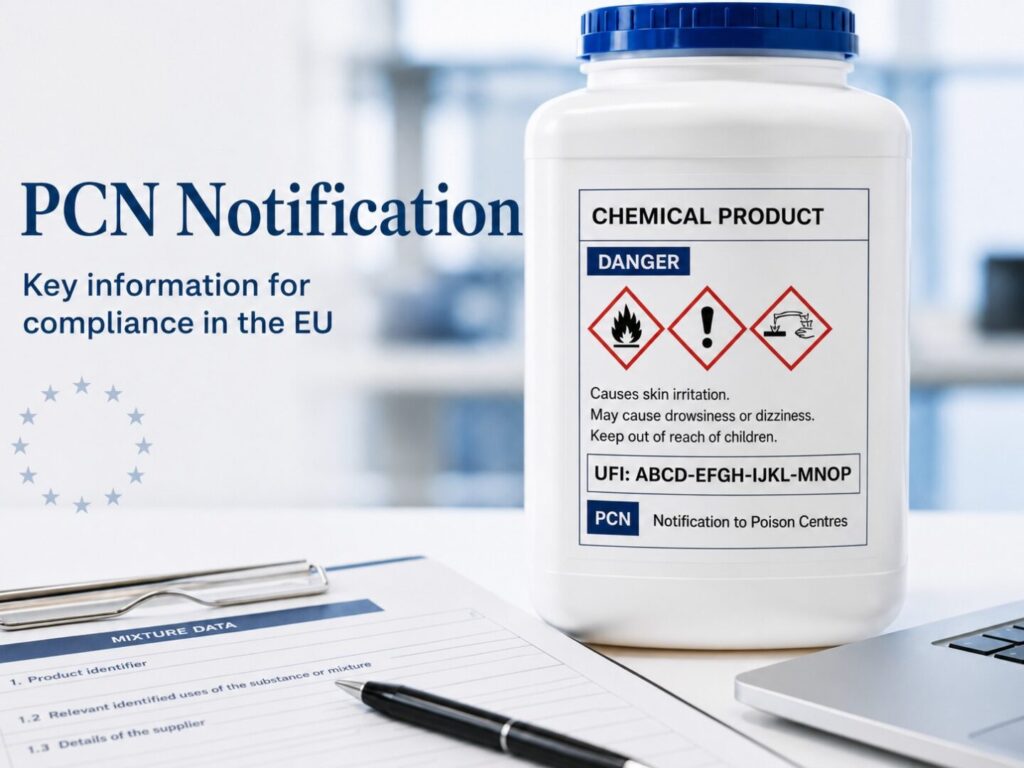
The placing on the market in the European Union of a chemical mixture classified as hazardous under Regulation (EC) No 1272/2008, due to its physical hazards or effects on human health, may require— in addition to a safety data sheet and a label compliant with the CLP Regulation—notification to the poison centres of each Member State in which the mixture is marketed. This is known as a PCN notification.
What is a PCN notification?
A PCN is a harmonised submission of information on certain hazardous mixtures to the appointed bodies and poison centres of the EU Member States.
PCN requirements are regulated at European level by Article 45 and Annex VIII of Regulation (EC) No 1272/2008, known as the CLP Regulation. These obligations apply to companies placing certain hazardous mixtures on the market in the European Union and the European Economic Area, regardless of the country in which the manufacturer is established.
The purpose is to ensure that poison centres receive consistent and sufficiently detailed information to provide an appropriate medical response in the event of poisoning or accidental exposure.
Which products are subject to PCN requirements?
As a general rule, the obligation applies to mixtures classified as hazardous due to their effects on human health or their physical hazards.
This may include mixtures classified as:
- Skin irritants or corrosives.
- Causing eye irritation or serious eye damage.
- Skin or respiratory sensitisers.
- Acutely toxic by oral, dermal or inhalation exposure.
- Aspiration hazards.
- Flammable or oxidising.
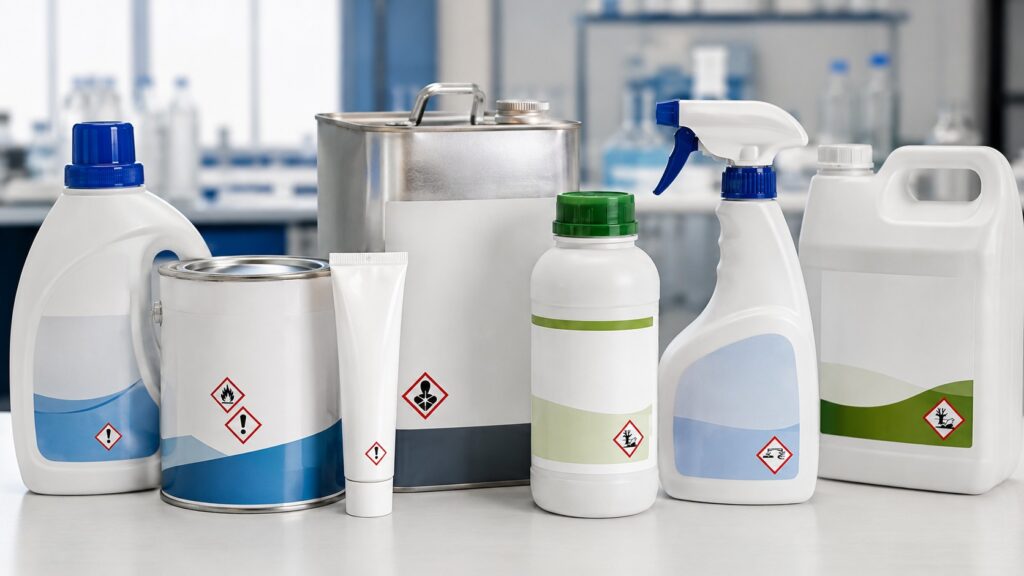
The obligation depends on the final classification of the mixture, rather than on the sector to which the product belongs.
Products that may therefore be affected include detergents, paints, adhesives, industrial products, fertilisers, biostimulants, biocides and plant protection products.
What information does a PCN contain?
A PCN includes information on the identification of the product and the responsible operator, the countries where it will be marketed, its intended use, classification, composition, toxicological information and UFI.
A safety data sheet does not always contain all the information required to prepare the notification, particularly when it does not disclose the full composition of the mixture.
What is the UFI?
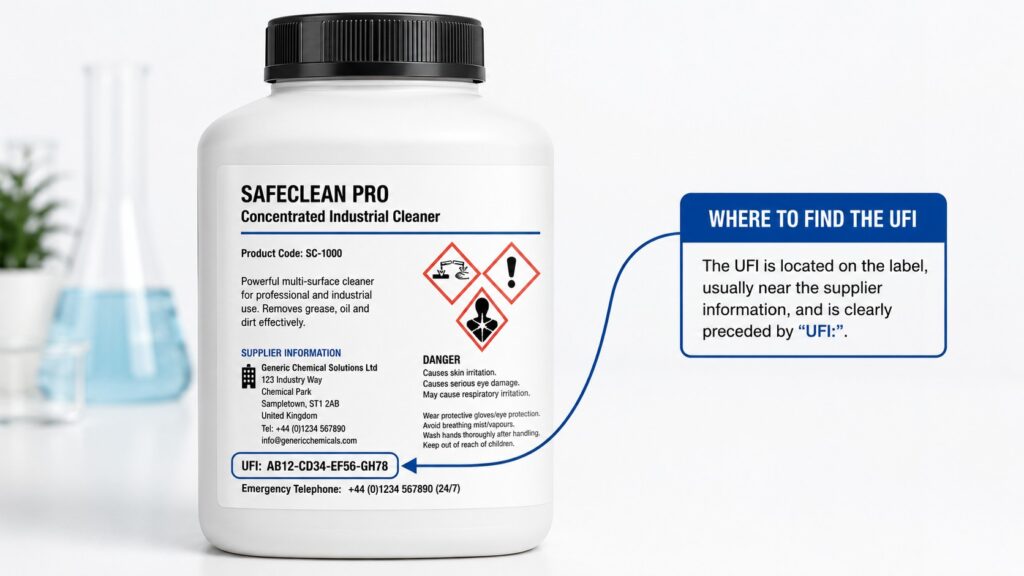
The Unique Formula Identifier, or UFI, is a 16-character alphanumeric code that links the product placed on the market to the information submitted in the PCN.
Its usual format is:
UFI: XXXX-XXXX-XXXX-XXXX
The basic principle is that each UFI must correspond to a single composition.
The same formulation may be marketed under different names and use the same UFI, provided that all trade names are included in the notification.
However, generating a UFI does not mean that the PCN has already been submitted. The code must be linked to a valid notification before the product is placed on the market.
Common mistakes
The most common mistakes include generating a UFI without submitting the PCN, using the same UFI for different compositions, omitting trade names or countries of sale, and failing to update the notification after changes to the product.
A prior regulatory review helps identify these inconsistencies and avoid problems during commercialisation.
PCN notification service
At Sun Chemicals Services, we help companies comply with their obligations regarding the notification of hazardous mixtures used in fertilisers and biostimulants.
We manage PCN submissions through the ECHA Submission Portal, including the creation and linking of the corresponding UFI code.
We also provide advice in relation to the CLP Regulation, concerning the classification, labelling and packaging of substances and mixtures for agricultural use.
This enables companies to centralise the management of the PCN, the UFI code and the regulatory information that must appear on the label.

For further information about our PCN notification and CLP labelling services, please contact our team.
July 2026
Sun Chemicals Services Team
#PCN #PoisonCentreNotification #UFI #CLPRegulation #ChemicalCompliance #ChemicalSafety #HazardousMixtures #ECHA #CLPLabeling #RegulatoryAffairs #ChemicalRegulation #SunChemicalsServices